
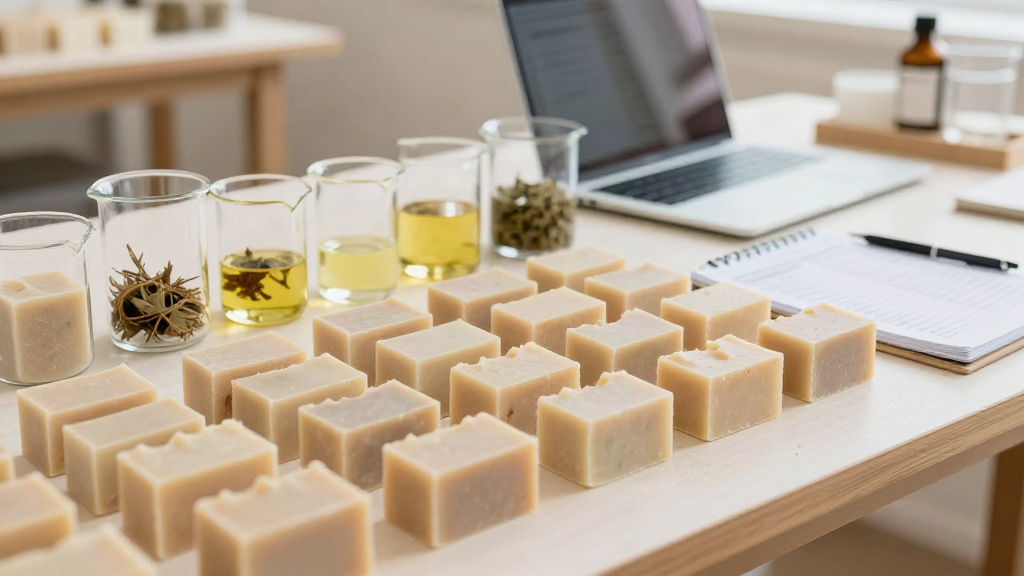
When you make soap in small batches, every experiment costs you twice. You pay for the oils, lye, fragrance, and packaging, and you pay in the weeks it takes to cure a batch and find out whether the recipe actually holds up. For a two-person operation, that waiting is the real bottleneck. Lab testing adds a second layer of cost on top, and most small makers cannot justify it on every idea they want to try.
This is the story of how one small soap brand worked through that problem with an AI soap formula generator, moving most of its early trial and error off the bench and onto a screen before committing to a physical test batch. The brand is a composite drawn from the kind of formulation-led, small-batch operations we hear from most often, and the figures below reflect typical ranges rather than one company's ledger.
The starting point: stuck between batch tests and a limited budget
The maker arrived with a familiar set of constraints. A solid base recipe that sold well. A handful of ideas for variants: a gentler bar for sensitive skin, a harder bar that lasted longer in the shower, a version built on a lower-cost oil blend. And no realistic way to test all of them quickly. Each physical test batch meant materials, cure time, and a hand-wash panel to see how the bar actually performed. Running six variants the old way could eat a full season. Paying for lab work on each one was simply out of reach on the budget.
Building and iterating the formula with AI before any physical trial
The workflow started with the Formula Generator. The maker entered the base recipe and the target properties, then let the tool propose ingredient ratios and flag where a change to one ingredient would ripple into hardness, lather, cleansing strength, or shelf stability. Instead of mixing and waiting, the maker compared several candidate formulas side by side in an afternoon.
Two tools did the supporting work. The Simulator tested how the ingredients in a candidate formula were likely to interact, which caught a pairing that looked fine on paper but was likely to shorten the bar's shelf life. The Barcode Scanner let the maker pull the ingredient list from a competitor bar they admired, so the comparison was grounded in products already on shelves rather than in guesswork.
What the first pass actually changed
By the time the maker ordered a single physical test batch, six ideas had already been narrowed down to two. The AI pass did not produce a finished product. It produced a shortlist and a set of reasons, which is exactly what a small maker needs before spending money.
What changed in cost, timeline, and confidence
Three things shifted. Cost dropped, because the maker paid for materials once instead of six times. Timeline compressed from a season of staggered batches to a few weeks, with the slow part now being cure time rather than the decision-making. And confidence went up in a specific, bounded way: the maker knew which changes were low-risk and which ones still needed a real bar in hand.
The confidence point is worth being precise about. This was not blind trust in a screen. It was a clear map of what had been checked and what had not, which made the remaining physical tests more targeted and the results easier to interpret.
What still needed a real-world check
This is the honest part, and it matters. A simulation is not a cure. The AI could predict how ingredients were likely to behave and flag interactions worth avoiding, but it could not tell the maker how the bar would feel in the shower, how the fragrance would hold after eight weeks on a shelf, or how a specific drum of oil would perform on the day it arrived. Those questions only get answered by making the bar, curing it, and testing it.
So the maker still ran a physical test batch, still waited out the cure, and still had one variant behave differently than predicted. The difference was that the surprise arrived on the second batch instead of the sixth, and it showed up as a tweak to correct rather than a direction to abandon.
Turning a one-off experiment into a repeatable process
The bigger win was the process. The maker now keeps a running list of candidate formulas in Suttain, records what the simulation predicted, and logs what the physical batch actually did. Over time that record becomes its own kind of lab notebook, one that belongs to the maker rather than sitting in someone else's file. When a new idea comes in, the maker starts from that history instead of a blank page.
What this means if you are a small-batch maker
You do not need a chemistry degree or a testing budget to get most of the way to a decision. You need a way to narrow your options cheaply, and you need to know which questions a screen can answer and which ones only a real bar can. That is the whole point of an AI soap formula generator used well: not to replace the bench, but to make sure the time you spend at it goes to the ideas most likely to matter.
Try it on your next formula
Suttain's Formula Generator, Simulator, and Barcode Scanner are free to start, no credit card required. You can generate and compare formulas, test likely ingredient interactions, and scan products to see how yours compares, then take only the strongest candidates to a physical batch. Begin with the free tier and see how much of your early trial and error you can move off the bench.
A small brand does not need to match a large lab's budget to make good formulation decisions. It needs better information before the first batch, and honest expectations about what still has to be proven by hand. That combination is what turns a costly guess into a manageable experiment.