
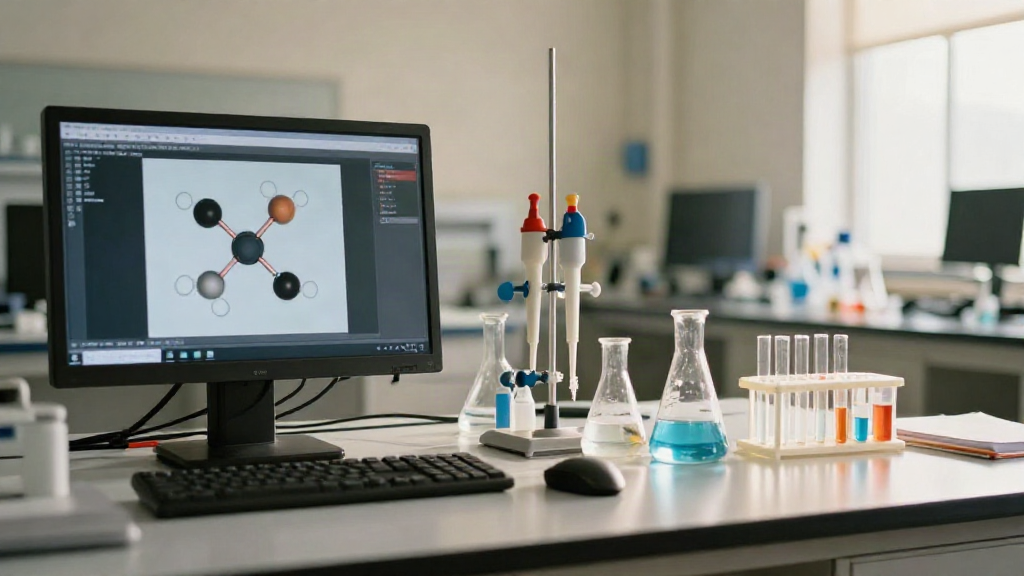
Every early-stage research plan runs into the same fork in the road: do you model the system on a computer first, or do you mix, heat, and measure it in the lab? The answer is not a matter of preference. It depends on the exact question you need answered, how much certainty the next step requires, and what you can afford in time and materials.
Atomistic simulation and wet lab experiments are not competitors fighting for the same job. They answer different questions and carry different kinds of risk. Understanding where each one is reliable, and where it quietly stops being reliable, is what turns a guess into a plan.
Two different ways to answer a chemical question
Atomistic simulation builds a model of a molecular system and computes how it behaves: how molecules interact, how a structure flexes, how strongly a candidate binds, or what a formulation is likely to do before anything exists in a beaker. It works with physics-based models and approximations rather than physical samples.
A wet lab experiment works the other way around. You make the thing, run the assay, and measure a real result in the real world, with all the messy variables that come with it. The output is an observation, not a prediction.
Neither is more scientific than the other. The question is which one is matched to what you are trying to learn right now.
What simulation answers well
Simulation is strongest when you need to look inside a system you cannot easily observe, or when you need to compare many options quickly.
Mechanisms and interactions. Simulation is a good fit for questions about how molecules behave at a level the eye cannot track: which interaction dominates, how a binding pocket changes shape, or why two ingredients are likely to interfere with each other. A simulator is a reasonable first stop when you want to reason about a mechanism before committing bench time to it.
Screening many candidates. Where a lab run tests one formulation or one compound at a time, a model can compare dozens or hundreds of candidates in the time it takes to prepare a single plate. That breadth is valuable early, when the goal is to narrow a field rather than confirm a final answer.
Impossible or expensive conditions. Some systems are hard to test directly: unstable intermediates, extreme conditions, or targets that are difficult to express. Simulation lets you study them when the bench cannot.
What wet lab experiments answer well
The laboratory is still the reference point for anything that has to hold up in the physical world.
Real-world behavior. Aggregation, solubility in the actual matrix, shelf stability, sensory properties, and the way a material behaves on real skin or a real surface are all things a model estimates at best. When the outcome depends on the full complexity of the physical system, measurement wins.
Regulatory and safety evidence. Claims that reach a regulator, a customer, or a safety filing usually need measured data. Simulation can guide and prioritize, but it does not replace the record an experiment produces.
Validation of the model itself. Every model has assumptions. Laboratory data is how you find out whether those assumptions hold for your system, and that feedback is what makes the next simulation more trustworthy.
Cost, speed, and coverage: the real tradeoff
The tradeoff is rarely about which method is better. It is about which resource you are spending and how much you have.
A simulation loop is usually fast and cheap per question and scales across many candidates, but every result carries model error that may not be obvious until you test it. A lab loop is expensive per data point and slow to iterate, but each result is grounded in reality and carries weight you can act on.
Seen that way, the two methods cover for each other's weaknesses. Simulation is a way to spend compute instead of reagents, so that the reagents you do spend go toward the few candidates and conditions that matter most.
Where each approach stops being reliable
Honesty about limits is what makes either method useful. Simulation is only as good as its model: force fields, solvation treatment, and the assumptions baked into a scoring function can all shift a result. A predicted binding affinity or stability value is a hypothesis, not a measurement, and it should be labeled that way.
Wet lab work has its own limits. It is precise about what it measures and silent about everything it does not. One assay rarely explains why a result occurred, and it can take many runs to map a trend that a model would have sketched in an afternoon.
The practical rule is simple: trust simulation for direction and ranking, and trust the lab for confirmation and anything that must survive contact with reality.
A practical decision framework
When you are planning an early research step, a few questions usually point to the right starting line.
If you can state the question as a comparison between many options, or as a question about a mechanism you cannot yet see, start with simulation. If the answer needs to stand up to a regulator, a customer, or a physical product spec, plan for the lab.
If the system is well characterized and the chemistry is familiar, existing data and a short bench run may be faster than building a model. If the system is new or poorly understood, modeling first keeps you from burning bench time on dead ends.
If the cost of being wrong is low and the answer is quick to measure, measure it. If the cost of being wrong is high, or the experiment is slow and expensive, model it first and use the lab to check the result.
Combining both: simulation first, lab second
The most efficient plans do not choose one method permanently. They sequence them.
Use simulation to map the space, rank candidates, and flag the interactions worth worrying about. Then take the short list to the lab and measure it. Feed those results back into the model so its next round of predictions is better calibrated to your system. Each cycle narrows the field and raises confidence at the same time.
That rhythm is how a research team gets the coverage of computation without giving up the ground truth of the bench.
Where Suttain fits
Suttain is built for exactly this sequencing. The Simulator lets you test chemical interactions and run atomistic simulations safely before anything reaches a bench, so you can rank candidates and surface risks early. The Research Portal keeps those workflows, source records, and assumptions in one reviewable place, from your first question to a documented research record.
You can start on the free tier, with no credit card required, and use simulation to decide what is worth measuring rather than measuring everything.
There is no single winner in the atomistic simulation versus wet lab debate, and framing it as a contest misses the point. Simulation is faster, cheaper, and broader; the lab is slower, costlier, and more definitive. A careful research plan uses each for what it does best: model first to decide what to test, then test to confirm what the model predicted, and let each step sharpen the next.